
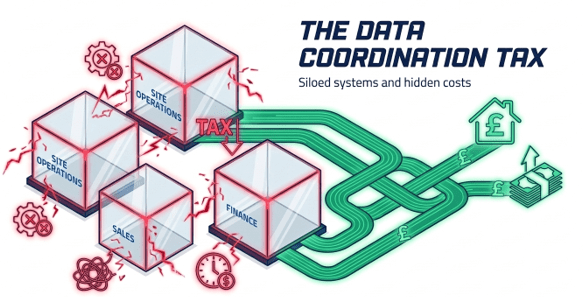
The data co-ordination tax refers to the hidden commercial friction and value erosion that occurs when functional teams operate in isolated silos rather than managing an end-to-end journey.
In the House Building sector, this coordination tax is particularly high because a single plot’s completion relies on three distinct departments that rarely share real-time, aligned data:
- Build & Site Operations: Focused primarily on physical construction milestones, subcontractor availability, and site safety.
- Sales & Conveyancing: Focused on buyer relationships, chain readiness, and target handover dates.
- Finance & Commercial: Focused on monthly cash flow targets, working capital, and overall site margin.
How the Coordination Tax Erodes House Building Value
When these three silos operate independently, the business pays a heavy “tax” in lost time, extra carrying costs, and delayed cash flow:
- Uncommunicated Schedule Slippage: A site manager encounters a 2-week bottleneck (such as the Plot 12 roofing stagnation). Because site systems aren’t linked to commercial cash flow, the delay isn’t immediately flagged to Sales or Finance.
- Mortgage Release Failure: Sales continues expecting legal completion on the original forecast date. When the deadline arrives and CML sign-off is missing, the mortgage company cannot release funds, unexpectedly locking up hundreds of thousands of pounds in working capital.
- Frictional Crisis Management: Instead of proactively clearing bottlenecks weeks in advance, teams waste executive time in emergency alignment meetings, paying premium rates for last-minute trade shifts or holding completed inventory while buyer mortgage offers expire.
Eliminating the Tax
Overcoming the coordination tax requires moving away from siloed metrics toward end-to-end plot data ownership. By using a unified risk model, any operational delay on-site automatically calculates the downstream financial impact, giving Build, Sales, and Finance a single source of truth to protect cash release dates simultaneously.